
UC Davis Turns Their Interactive Map and Virtual Tour Into a High-Intent Inquiry Engine
About The University of California, Davis
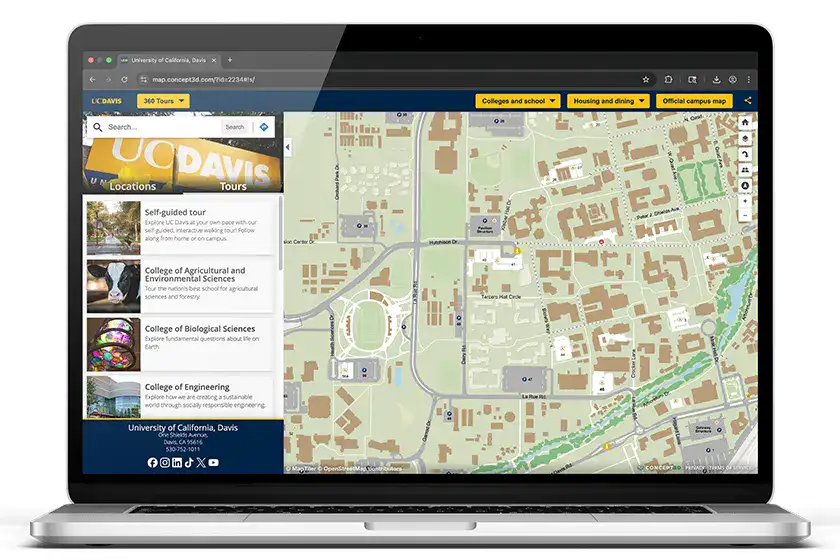
The University of California, Davis (UC Davis), a leading public research university located in Davis, California, serves over 31,000 undergraduates. To better showcase its expansive, dynamic campus to prospective students and families, the university partnered with Concept3D to create an interactive campus map and virtual tour, offering an engaging experience for on-campus visitors, remote audiences, and admitted students exploring from anywhere.
First Year Key Outcomes:
- Several thousand student inquiries generated directly from the virtual tour and self-guided map embedded inquiry form
- Roughly half as many additional inquiries from parents and guardians
- Largest inquiry volume in March, aligning with spring yield season
- 50–75% engagement lifts at key points in the cycle compared with early baseline periods
“I truly feel it’s a partnership, not just a product that’s plopped in our plate”
Jenny Carrick, Director of Marketing & Communications for Undergraduate Admissions

The Solution: Interactive Map, Virtual Tour and Slate Integration
Embedded Inquiry Forms
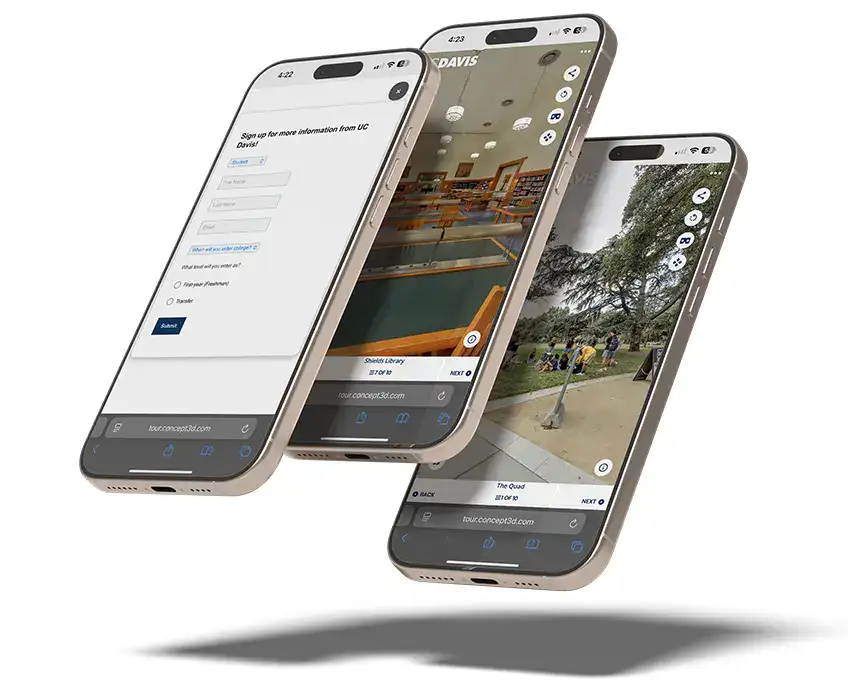
Working with Concept3D, a preferred Slate partner with direct integration, UC Davis embedded an RFI form directly into their virtual tour and self-guided tour embedded into their interactive map.
The data captured fed into their Slate CRM and enabled the admissions team to identify who was engaging, segment inquiries by student type and lifecycle stage, and trigger appropriate follow-up nurture communications.
Two Complementary Experiences
Usage data now validates UC Davis’ strategic split:
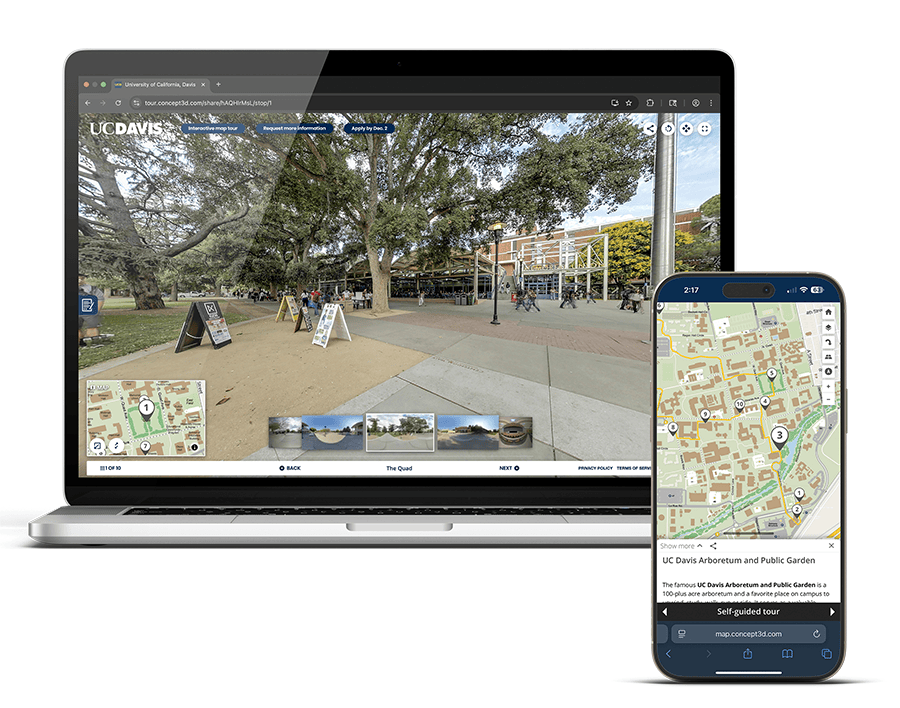
- Virtual Tour (desktop-heavy):
- Primarily used during spring yield season, especially March.
- Serves admitted and non-local students who cannot travel to campus.
- Interactive Map (mobile-heavy):
- Used mostly by on-site visitors taking self-guided tours.
- Replaces printed maps and introduces a natural opt-in point.
“We’re seeing mobile users who are here on-site taking that self-guided tour and exploring other tours we have. That’s exactly what we hoped the data would show,” Carrick said.
Vendor Selection & Partnership
UC Davis evaluated several self-guided tour vendors, but ultimately chose to expand with Concept3D to keep vendor management simple and their digital suite under one roof. Ultimately, the tailored solution proved indispensable for UC Davis who preferred a non-generic option that addressed the institution’s specific goals.
“Everyone felt building on what we already had with Concept3D was the way to go. I appreciated that they focused on how we would use these products—not just selling us something off-the-shelf.”
Jenny Carrick, Director of Marketing & Communications for Undergraduate Admissions
Results: From Anonymous Usage to High-Intent Leads
In the first 12 months with embedded inquiry forms:
- The virtual tour and interactive map together generated several thousand student inquiries (specific numbers kept confidential for internal purposes).
- A dedicated family form produced a few thousand inquiries from parents and guardians.
This strategy transformed maps and tours from stealth traffic into a high-intent, trackable audience that didn’t exist when experiences were PDF-based or unconnected to the CRM.
Seasonal Performance & Lift
At key points of the year, UC Davis has seen 50–75% jumps in engagement compared with early baseline months, showing that diversified tools plus embedded forms amplify interest when decisions matter most. Their largest inquiry month is March which directly aligns with yield season.
Better Student Journey Insight
With inquiries flowing into Slate, the team can now analyze:
- Whether submitters are early-stage prospects (e.g., 9th–11th graders)
- Seniors or admitted students in a short decision window
- Parents and families engaging around the same visit
“Data is critical for us to understand who our prospective and admitted students are, but it’s also highly protected. The integration with our CRM gives us the insight we need while allowing us to protect that data appropriately.”
Jenny Carrick, Director of Marketing & Communications for Undergraduate Admissions
Primary Goals
The admissions marketing team set four clear objectives:

Diversify the tour ecosystem
- Keep the virtual tour for remote and admitted students.
- Add a mobile-first self-guided tour for visitors already on campus.

Turn engagement into identifiable inquiries
- Capture student and family information via embedded RFI forms.
- Flow that data directly into Slate, their CRM.

Replace static PDFs with interactive experiences
- Move beyond a simple PDF map to an interactive, data-rich experience.

Maintain accessibility and intuitive UX
- Align with WCAG expectations and ensure the experience is mobile-friendly and intuitive.
“We had data on usage of the virtual tour—when people were using it and which stops they viewed—but we had no data that reflected the impact of that. We didn’t know who they were or what it resulted in,” Carrick explains.
At the same time, on-campus visitors relied on a printed self-guided map. The team only knew how many maps were printed, not who picked them up or whether those visitors ever inquired or applied.
Accessibility & Experience
Accessibility and mobile usability were central, especially for the self-guided map experience. During the vendor evaluation process the team pushed on questions that addressed mobile responsiveness, intuitive UX design and screen reader compatibility.
The Concept3D delivered on properly labeling buildings and various locations across campus so they were fully accessible, a feat the internal team at UC Davis didn’t have the capacity to execute on its own.
“For Concept3D to come back and say, ‘We need to make this accessible—we’re going to take that on,’ showed us a lot about their commitment to accessibility.”
Jenny Carrick, Director of Marketing & Communications for Undergraduate Admissions
Longterm Impact
For Carrick, the shift is about more than replacing a PDF:
- Digital-native expectations: Gen Z and Gen Alpha expect interactive, personalized experiences.
- Family decision-making: Tools must engage both students and the people closely advising them.
- Earlier relationship-building: UC Davis now has meaningful touchpoints before students ever start an application.
“We need to have that personal engagement long before they’re filling out the application. These tools help us share what might make UC Davis the right place for students and their families,” Carrick explains.
And on the relationship with Concept3D:
“We’re so pleased with how responsive everyone is and how willing they are to make it work within our processes. I truly feel it’s a partnership, not just a product handed off to us.”
Jenny Carrick, Director of Marketing & Communications for Undergraduate Admissions



Transform your online experience.
See our technology solutions come together in one seamless experience.