

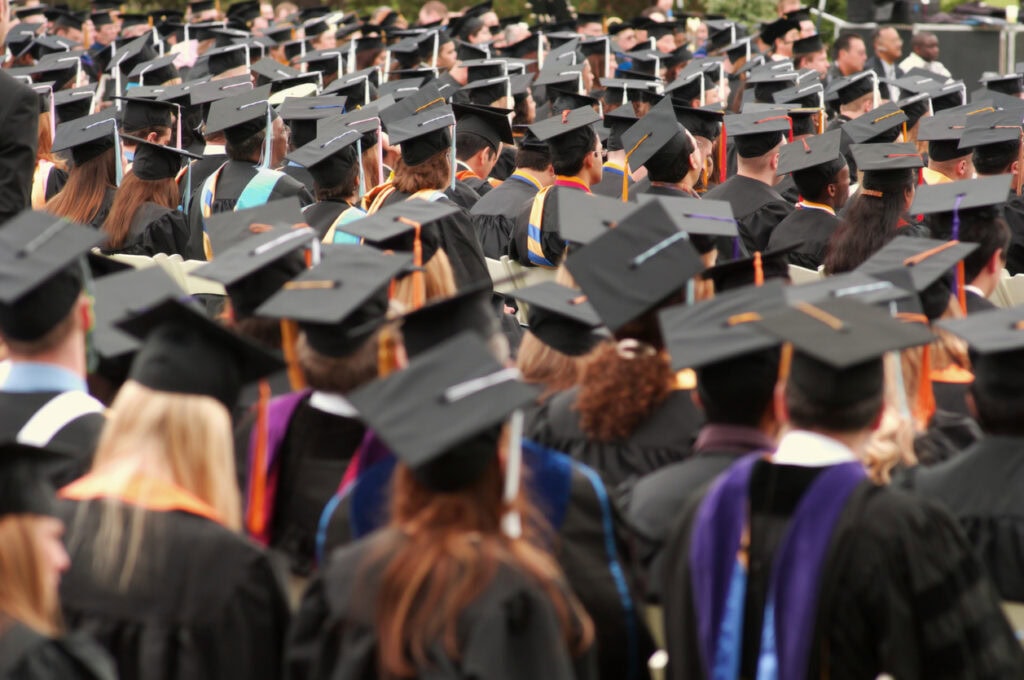
Without a doubt, commencement is the largest event most universities host every year. Major universities graduate as many as 10,000 students each spring, with large ceremonies attracting 20,000 or more attendees. That’s before we even get to the complexity of the event, with many schools hosting multiple ceremonies across a single weekend. To attendees, a successful university commencement should feel seamless. But behind the scenes, it requires months of logistical coordination, cross-campus planning, and operational precision. Knowing how to organize university commencement can even seem like it requires a college degree in its own right.
The challenges of large university commencements and small school ceremonies alike are undeniable. Coordination, clear communication, and infrastructure—both digital and physical—are vital to planning a successful event that graduates and their families will remember for a lifetime.
The True Scale of Commencement Logistics
To the graduates and their families, it’s all about that one magical moment of crossing the stage. To make that moment happen, university commencement challenges abound, starting with the sheer scale of the event.
It’s not uncommon for many universities to graduate upwards of 5,000 students each spring. Each of them tends to bring between two and six guests, depending on the venue’s capacity. At some of the largest universities, when no single venue can accommodate all attendees, five or more ceremonies may occur on the same weekend.
The operational impact is immense. Parking on campus is often not set up to accommodate all guests. The number of staff and volunteers required can easily reach the hundreds. Livestreams, which have become increasingly popular in the last six years, only add to the many challenges of large university commencements.
Put it all together, and a successful university commencement is essentially a multi-day operation that transforms the entire campus into a large-scale event venue. Operational manuals alone, when written down, can easily span hundreds of pages to keep everyone aligned.
The Hidden Operational Challenges Behind Commencement
Any event of that scale and magnitude will almost necessarily introduce complications. But proactively accounting for university commencement challenges makes them more manageable. Broadly speaking, planning a successful university commencement requires an accounting of four logistical pillars that can easily become complications if not managed properly.
1. Cross-Department Coordination
Those with experience in how to organize university commencement know: planning involves close collaboration among nearly every operational unit on campus.
Key stakeholders include the registrar’s office, student affairs, event management, facilities, transportation and parking, campus safety, communication and marketing, and IT and AV teams. You also need to consider units like the alumni office. It might not have a logistical role in the core event. But it may plan its own related events to welcome new members of the alumni family.
These units will need to work closely together months ahead of the actual event, including engaging in activities like:
- Coordinating graduate eligibility lists for the event itself and any printed or online programs
- Planning venue layouts for both logistics, campus safety, and visitor and graduate experience
- Managing ticketing distribution to graduates and their families, as well as relevant faculty and staff
- Organizing volunteer staffing for parking lots, ushering families, and other day-of tasks
- And more
Put simply, a successful university commencement requires institution-wide coordination among many teams on campus and across their systems. Everyone needs aligned timelines so that every piece of the puzzle fits together.
2. Managing Thousands of Visitors on Campus
For graduates, commencement marks the end of years on campus. But for many of their families, commencement may be their first time visiting campus. Managing this wide range of visitors adds to the many university commencement challenges institutions tend to encounter.
That process starts with the basics. Visitors will need to be able to easily find the correct ceremony venue, especially (but not only) if multiple ceremonies are scheduled for the same day. They’ll navigate unfamiliar parking areas, find the correct entrance, and find their assigned seats.
For some of them, accessibility becomes a key concern. Finding accessible routes, entrances, and elevators can make or break their commencement experience.
Poor navigation creates congestion and delays, not to mention a level of stress that can ruin the entire ceremony. But smooth wayfinding, shuttle routes, and navigation, on the other hand, can play a significant role in making thousands of visitors feel welcome.
3. Coordinating Multiple Ceremonies and Event Schedules
Universities with larger enrollments have moved to hosting multiple ceremonies to alleviate the challenges of a single event. They schedule ceremonies by college, department, or degree level. This offers a more focused experience that feels more intimate and relevant to each graduate. While this approach undoubtedly has its merits, it also presents its own challenges for university commencement.
If the ceremonies are happening at different times in the same venue, a successful university commencement has to account for resetting that venue between ceremonies. Coordinating graduate lineups also becomes more complex, especially when students may participate in multiple ceremonies.
That complexity then extends to faculty. Many faculty teach in multiple departments, or may want to attend ceremonies for all of their students.
Finally, IT-related challenges cannot be underestimated. From staging and AV transitions to coordinating the production of multiple livestreams without a hitch, it requires not just the right equipment but also a well-coordinated technology team ready to step in throughout the weekend. It’s a highly choreographed production schedule that requires input and expertise from every corner of campus.
4. Safety, Accessibility, and Risk Planning
All large-scale events require extensive planning for safety and accessibility. It’s only natural, then, that the largest-scale event on your campus will require the most comprehensive planning in these areas, as well.
Successful university commencement planning will require extensive crowd management plans and coordination with local emergency and medical services. If the weekend includes any exterior components, weather contingency plans become crucial.
Of course, ADA accessibility for commencement becomes a central priority. From the venue to parking, and from accessible wayfinding to digital accommodation, everyone in the crowd should be able to enjoy their graduates’ big day equally. Components such as wheelchair seating areas, accessible routes, and ASL interpreters are vital to consider early in the planning stage to balance safety with inclusivity.
How Technology Helps Universities Manage Commencement
Considering all of these challenges and complexities, a comprehensive plan of how to organize university commencement requires much more than digital tools. That said, technology can increasingly support the planning of a successful university commencement by:
- Centralizing event information
- Reducing confusion for your guests
- Improving communication across the board
That starts with interactive campus maps. The right maps can display everything from ceremony venues to parking locations, shuttle stops (including real-time shuttle arrivals), accessible routes, and reception locations after the ceremony. Built the right way, they can become comprehensive communication and wayfinding hubs, helping all visitors get to the right spot at the right time with minimal stress.
But it doesn’t end there. Event management platforms can highlight various campus happenings in an easy overview, alleviating some of the challenges of large university commencement, especially. On the backend, the same platform can track attendance, help with digital ticketing, and keep internal stakeholders aligned.
Beyond these core systems, the infrastructure for livestreams will also be crucial. The stream should hook into the event’s cameras and equipment and connect directly to digital platforms like YouTube or Vimeo, allowing virtual guests to still participate in a successful university commencement.
Moving part of your experience into a virtual environment has become increasingly vital in recent years. Today’s college students increasingly expect real-time information, with as much information available on their phones as the printed programs in their hands. The more centralized that information is, from digital wayfinding to livestreams, the more positive the visitor experience can become.
In short, technology has the potential to transform your commencement logistics. Rather than having to manage a series of disconnected systems, it can unify the commencement for planners and attendees alike into a coordinated campus experience.
Turning Complexity Into a Seamless Experience
For your graduating students and their families, commencement only lasts a few hours, and the most important moment only lasts a minute or less. But planning a truly successful university commencement requires months of preparation, cross-departmental collaboration, and detailed operational planning, including both physical and technological nuances.
Only intentional planning with all internal stakeholders can overcome this complexity and help you pull off a successful event at this scale. When you get it right, the payoff for both your institution and your graduates will be immense.
Done right, successful commencement planning creates a smooth and memorable experience for graduates and their families that will stick with them for life. The broader campus community, meanwhile, will appreciate an appropriate send-off for the students that they have walked with for years. Account for the complexities, and you can nourish lifelong relationships with graduates that will always look back fondly on their experience of walking across the stage and closing that chapter in their lives.
FAQs
How many people typically attend a university commencement?
Large university commencements can attract tens of thousands of attendees, including graduates, families, faculty, and staff. Some of our partners report ceremonies with attendance exceeding 20,000 people.
How many guests can graduates invite to the commencement ceremony?
Most commonly, universities allow between four and six guests per graduate. Many universities limit guest tickets due to venue capacity, and some may allow fewer as a result.
Why do universities host multiple commencement ceremonies?
Large graduating classes often require separate ceremonies by college or department. Some institutions also separate ceremonies by degree level to manage attendance and ensure each graduate can be individually recognized.
How far in advance do universities plan commencement?
Most institutions begin planning commencement between six and 12 months ahead of the ceremony. As soon as one ceremony finishes, takeaways can inform future planning to address the complexities of coordinating venues, staffing, logistics, and communications.
What technology helps universities manage commencement events?
Common technology tools include event management platforms, interactive campus maps, livestream technology, and transportation tracking systems. These tools help universities coordinate logistics and improve the experience for guests and graduates.