
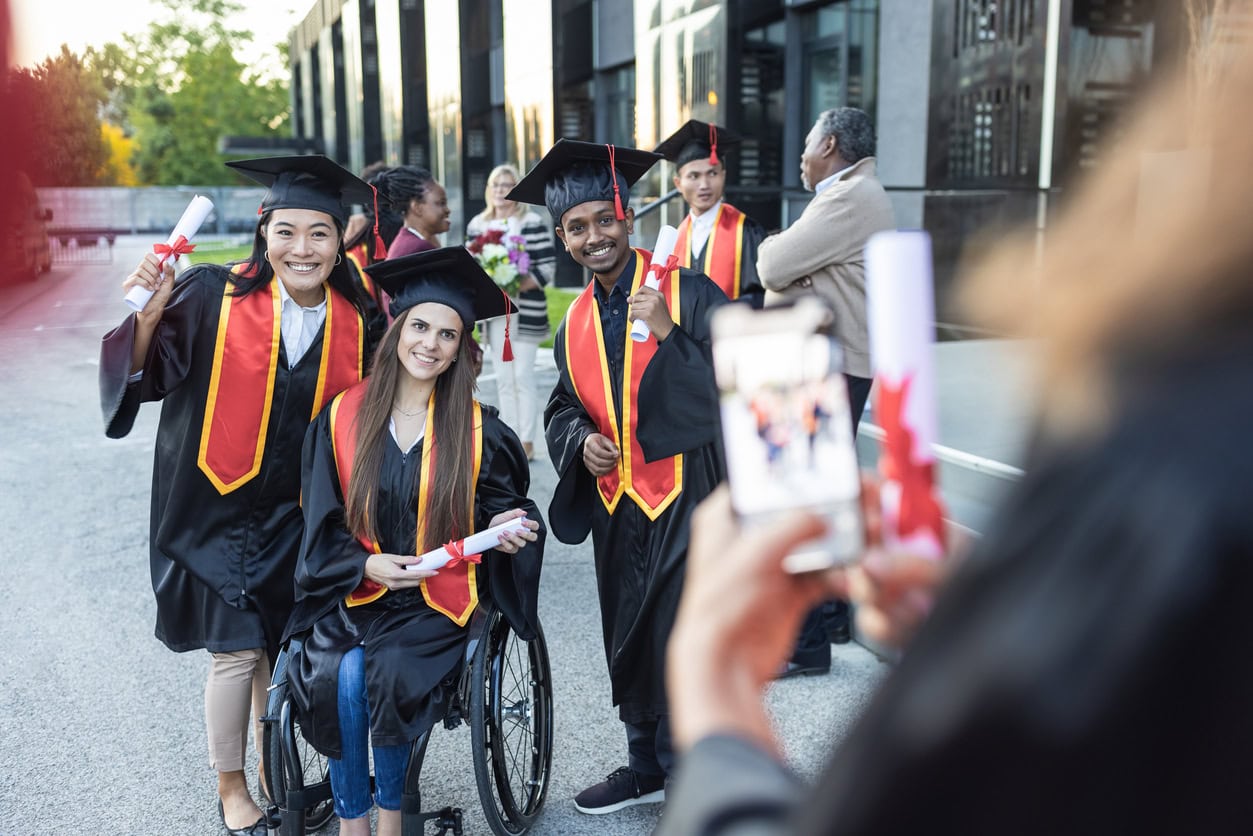
Every spring, commencement becomes the organizational center of the university calendar. It’s one of the most important and emotional events for students, faculty, and staff alike, with families traveling from across the country (and even internationally) to celebrate the graduating class. But for many visitors, especially those living with disabilities or mobility challenges, not having an accessible commencement means not having a commencement at all. Navigating campus on commencement day can be confusing and stressful to the point of minimizing what should be a celebration.
Campus is already a complex organism during the regular school year. It becomes even more complicated during graduation. Temporary venues, overflow parking, multiple ceremony locations, and thousands of first-time visitors all combine to make accessible university navigation a key need for a smooth event.
Approximately one in four residents in the United States lives with a disability. Done right, an accessible commencement enables visitors to move across campus confidently and independently.
Why Commencement Creates Unique Accessibility Challenges
An accessible commencement, of course, is far from a given. For most schools, graduation is the largest annual gathering on campus. It brings together thousands of guests who may be visiting the university for the first time. Also, according to the U.S. Centers for Disease Control, nearly 30% of them live with a disability.
The sheer size of the event and the logistics required to plan it combine to make accessible commencement navigation a unique challenge compared to other university events. Many visitors will be unfamiliar with the campus layout. Even those who know the campus may be stumped by the temporary nature of campus infrastructure. Distances between parking and venues, congested pathways, and limited accessible entrances at each venue all complicate the goal of an accessible commencement.
As a result, several organizations have published accessibility guidance specifically for commencement. These groups, ranging from the National Center on College Students with Disabilities to the Association on Higher Education and Disability, provide university commencement accessibility tips that can help universities plan their own guidelines.
But challenges remain. National studies consistently find that the majority of institutions present day-to-day mobility barriers. They tend to get worse during large events like graduation. These barriers can be physical, as mentioned above, or digital, which has become increasingly urgent as federal rules require accessibility on websites and other interactive tools.
Accessibility Is Evolving, From Compliance to Experience
Historically, and perhaps understandably given the number of rules and guidelines, accessibility in higher education has focused on compliance. To be sure, planning an accessible commencement still has to include checklist items like ADA seating sections, wheelchair ramps, and elevator access. But while these elements remain essential, institutions are increasingly recognizing that accessibility must extend beyond physical infrastructure.
It’s why any university commencement accessibility tips have to include independent navigation and digital accessibility, as well.
In addition to physically navigating the campus and venues, campus visitors need to easily identify which routes are accessible and locate accessible entrances. They should be able to find elevators and restrooms that suit their needs, with the ultimate goal of navigating campus without assistance.
Stories about colleges not fully accommodating their students’ digital accessibility needs have become more common as digital experiences have become more central to the college experience. The World Wide Web Consortium (W3C)’s WCAG guidelines are increasingly becoming the gold standard against which institutions model their digital presence. These guidelines help support an online and mobile experience as independent as physical wayfinding on campus.
During graduation, this approach to creating a virtually accessible commencement navigation experience becomes increasingly important. By providing independent digital wayfinding for all visitors, institutions can reduce the need for staff to support that navigation, improving not just the visitor experience but also internal logistics.
What Higher Education Is Saying About Accessible Campus Experiences
Across higher education, administrators are recognizing that accessibility is closely connected to visitor experience. Accessible university navigation, especially during major events, can go a long way toward creating an event that visitors (and those they come to celebrate) remember for a lifetime.
It’s why institutions are investing in strategic initiatives designed to create positive visitor experiences that integrate physical and virtual components:
- Colgate University created an interactive campus map with specific accessibility components, including a layer showing ADA parking spots, accessible routes, and entrances.
- High Point University built a digital ecosystem that is both integrated across touchpoints and accessible. It’s easy to use on mobile devices and for anyone with disabilities.
- Idaho State University beat the April ADA deadline with an interactive map that checks all WCAG boxes while improving user experience for all visitors.
Not every solution is limited to virtual maps. Improved signage systems across campus, especially when integrated with a digital map, make it easier to find the way. Institutions have also leveraged more universal design frameworks to make it clear which signage is most relevant to commencement visitors.
Increasingly, institutions like Oregon State University are sharing resources with their own campus communities, as well. The goal is making accessibility, from accessible commencement navigation to everyday life on campus, a key institutional priority for the entire community.
The Accessible Commencement Journey

Creating a strategy for truly accessible university navigation may seem like a mammoth task, especially when considering major events like commencement. The framework below can change the approach from a one-time effort to implementing accessibility consistently and comprehensively across the entire commencement visitor’s journey.
Stage 1: Pre-Arrival Planning
A truly accessible commencement starts long before your visitors arrive. As they plan their trip, they should already have access to key information, including (but not limited to):
- Accessible parking locations, including spots with ADA accommodations
- Convenient drop-off areas for visitors who may have one passenger with disabilities
- Accessible venue entrances, especially when not all of the venue’s entrances are accessible
- Accessible transportation options, particularly when the journey from the parking lot to the venue is longer
Most Americans use their phone’s or car’s GPS to navigate for trips longer than a few minutes. Integrating your digital commencement navigation with these wayfinding tools and communicating this information in advance can be a core part of a positive experience.
Stage 2: Arrival and Orientation
Once visitors arrive on campus, they need to orient themselves quickly. Anyone confused while on campus can create a roadblock for other visitors. They’ll also decrease their own chances of remembering the event positively.
When faced with too much information at once, visitors can experience cognitive overload, preventing them from processing it. Larger campuses, especially, can become overwhelming quickly.
Your communication at this stage should focus on minimizing information overload. Help your visitors quickly understand where they are, where they need to go, and how they can most effectively reach the venue. Avoid any information that may simply not be necessary at the point of arrival.
Stage 3: On-Campus Navigation
Once they reach the venue, visitors may need to navigate between multiple locations. They want to find their ceremony seating quickly. But they may also need to know where the restrooms are, where to take great photos, and how to get from one transportation area to the next. Finally, they might attend secondary reception events to which they’ll need to navigate.
At this stage, accessible commencement navigation tools can help them identify key areas, such as ramps, elevators, entrances, and accessible pathways. Finding the shortest possible distances is also key. While most Americans can walk for a few minutes, anything over 15 minutes can become a struggle, even for visitors with minor disabilities. The easier the navigation, the better.
Stage 4: Post-Ceremony Movement
No university commencement accessibility tips can end at the ceremony. Once it’s complete, large crowds will try to leave at once, heading to a reception, lunch, or back to their cars. Graduates may want to visit key campus landmarks one last time for a picture opportunity.
These large crowds all need to be managed equally well. Helping them find their way to their next destination rounds out a truly accessible commencement, ensuring the day ends as smoothly as it began for everyone involved.
Why Accessible Navigation Is Becoming a Strategic Priority

Visitors have always needed an accessibility plan to truly enjoy graduation. At the same time, an accessible commencement has become a key institutional priority in recent years for three major reasons:
- Aging visitor demographics
- Rising accessibility expectations
- Enhanced institutional inclusion commitments
Aging Visitor Demographics
Graduation ceremonies tend to bring out whole families. Grandparents and other older family members all want to see graduates cross the stage, and that population is getting older.
According to the National Center for Health Statistics, the average age of parenthood is older than ever. It’s a major reason why, according to the Population Reference Bureau, the U.S. population continues to get older. Nearly half of all older adults have a disability, increasing the need for an accessible commencement and campus.
Rising Accessibility Expectations
In addition to, and partially as a result of, demographic trends, visitors increasingly expect higher education institutions to provide digital experiences. It’s a major reason why lawsuits related to digital accessibility are on the rise, creating potentially significant legal jeopardy for institutions not following the trend.
The takeaway is simple. Consumers and campus visitors have realized that accessibility is possible in both the physical and the digital worlds. They’re prepared to take action if their needs are not met, no longer satisfied with a worse experience than their peers who do not live with a disability.
Institutional Commitments to Inclusion
Finally, accessibility has become a central pillar in the diversity and inclusion strategies of many institutions. After all, inclusion is about creating an equitable experience for anyone, regardless of physical limitations or background.
This commitment is as practical as it is ideological. More than one in five college students lives with a disability today. Not accommodating this group risks excluding a significant part of your student and prospective student body. It’s only natural, then, to extend that commitment from college life to major events like commencement.
The Future of Accessible Campus Navigation
While accessibility is already a key priority today, new technological advances will only continue to expand the possibilities of creating a truly accessible commencement and campus navigation. New tools are emerging that can help institutions support visitors with mobility impairments, visual impairments, cognitive challenges, and more.
For example, GPS-enabled campus navigation can help visitors find not only the parking lot but also the right walking path to the venue. For large locations, walking instructions can even extend indoors. Audio guidance can enhance the process for anyone with impaired vision. For traffic concerns or temporary parking solutions, real-time route updates keep visitors on track.
Tools with accessibility overlays can build more comprehensive resources for visitors. They offer a single spot for anything from entrances to restrooms, transportation options, AEDs, and more.
Smart campus initiatives are providing hints at what the future may hold. A single experience, integrated digitally and physically, makes it simple to both navigate and enjoy campus to its fullest. The key is not just a one-time accessible event, but a comprehensive, sustainable, inclusive campus design that enhances the lives of everyone involved.
Creating Commencement Experiences Without Physical or Digital Barriers
For graduates and their families, commencement represents the culmination of years of hard work. To get there is a massive logistical undertaking for university staff. But that undertaking is necessary for every visitor to be able to participate in the celebration without unnecessary obstacles.
At its best, an accessible commencement navigation experience supports equity and independence, significantly enhancing visitor experience in the meantime. If you get it right, you can create an event that visitors will remember for years, significantly enhancing your institutional reputation in the process, as well.
By prioritizing accessible navigation across the commencement journey, universities can ensure that graduation remains a day defined by celebration. From arrival to departure, removing barriers and logistical challenges creates an experience that doesn’t just check points off an accessibility checklist but turns the concept into a priority from which everyone can benefit.