

Campus space and room scheduling has never been more complicated to manage. A classroom that hosts three classes on Monday might be reserved for a student organization on Tuesday, a department meeting on Wednesday, and a prospective student information session on Thursday. Meanwhile, the conference room down the hall sits empty most of the week because nobody knows it’s available to book or even how to book it. For many universities, this is the current reality.
Research estimates that about 40% of campus space goes either unused or underutilized on any given day, even as schedulers field back-to-back requests for the same handful of popular rooms. Underlying the problem is a university room scheduling process that hasn’t kept pace with how most institutions actually use their facilities.
Fortunately, solutions are already available. This guide breaks down why room scheduling has grown more difficult, where the most common breakdowns happen, and what institutions can do to fix them.
Why Room Scheduling Has Gotten Harder
Thinking back to a simpler time of how to manage university room scheduling is not just nostalgia. The process has actually become more complex, with three common reasons at the core of the issue.
1. The Same Spaces Serve More Purposes
Classrooms double as meeting rooms, while student centers host academic programming alongside events. Conference spaces rotate among external rentals, faculty gatherings, and student group meetings. Each of these needs requires a different setup or type of space, with more cooks in the kitchen and groups involved in hosting the events.
2. More Campus Teams Need the Same Spaces
Partially as a result of the same spaces serving multiple purposes, scheduling needs have become more complex. After all, anyone from academic departments to student organizations and external community partners is competing for the same scheduling inventory. They might all have different booking processes or preferences, which will inevitably lead to conflicts and conflicting priorities if not managed centrally.
3. Manual Processes Create Operational Drag
Most university room scheduling problems start small. They may consist of an event request arriving by mail or a last-minute change that needs to be made. Most often, they happen manually, via email or even a text message between administrators. The result is extra work that no one anticipated or planned for, all while having to reconcile different bookings at different priority levels.
6 Room Scheduling Challenges Universities Face
The general problems above manifest themselves in issues that administrators across campus have to face on a regular basis. Most commonly, these challenges revolve around finding the right space, coordinating multiple services, and preventing scheduling conflicts.
1. Finding the Right Space
Effective room scheduling requires searching by a wide range of variables:
- Capacity
- AV capabilities
- Furniture layout
- Accessibility features
- Allowed uses such as food and beverage
- Amplified sound
- External guests
- And more
Simply put, a 200-person lecture hall is the wrong answer for a 15-person department meeting, even if it’s available. Limited search tools cause users to default to familiar rooms or email the events office, neither of which is scalable.
2. Managing Different Reservation Rules
A student organization booking a study room operates under entirely different rules than a conference team reserving an event space for an external client. Booking limits, setup buffers, cancellation policies, billing requirements, and approval workflows all vary by space, user role, and purpose. Without room scheduling solutions that enforce these rules automatically, administrators spend significant time on each of these nuances and adjustments.
3. Coordinating Campus Services
Reserving a room is rarely the whole job. A catered event needs facilities for setup, IT for AV, security for after-hours access, and custodial for post-event cleanup. Chains of emails are not nearly enough to coordinate all of these services, frequently leading to gaps and missed opportunities. Knowing how to manage university room scheduling means treating this coordination as part of the core workflow.
4. Preventing Scheduling Conflicts
Double bookings are the most visible symptom of a broken room scheduling process, but they’re not the only one. Recurring reservations that block space during high-demand periods, competing department requests for the same room, and unresolved approval queues all create friction.
So can the often-overlooked conflict between event scheduling and academic scheduling. When room scheduling solutions don’t integrate with the registrar’s course scheduling system, people double-book classrooms. A system that prevents these types of conflicts is fundamental to avoiding significant stressors on campus.
5. Keeping Reservation Information Current
A confirmed reservation is only useful if everyone who needs to act on it has accurate, up-to-date information. Personal calendars, department calendars, digital signage displays, and event schedules all need to reflect the same reality, which also needs to be updated when a reservation changes or gets cancelled. Manual synchronization creates gaps and misinformation that can ultimately erode trust in the entire room scheduling system.
6. Understanding How Campus Spaces Are Actually Used
Most institutions have hunches about which rooms get overbooked and which go underused, but having tangible data to support those hunches is less common. Higher ed space usage trends show that office and workspace utilization fluctuates significantly with the academic calendar, making it easy to misread peak-period pressure as a chronic shortage. Without utilization data tied directly to university room scheduling, institutions can’t distinguish between spaces that need capacity expansion and spaces that simply need better scheduling.
Why Better Room Scheduling Matters Beyond Reservations

Beyond the daily headaches, manual and inefficient room scheduling processes can also have more significant and longer-term effects on campus.
Operational Efficiency
Every hour a staff member spends resolving a double booking or manually syncing reservation data is an hour they can’t spend on program quality or student support. Streamlined processes of how to manage university room scheduling reduce that drag, all while creating an audit trail that makes conflict resolution faster when it does occur.
Maximizing and Monetizing Campus Space
Underutilized campus space is a missed revenue opportunity. Many universities are actively looking to generate income from spaces that sit empty during evenings, weekends, and summer sessions through conference rentals, community partnerships, and external event hosting. Utilization data that reveals underuse also identifies which spaces are in highest demand and best positioned for revenue-generating bookings.
Of course, that’s only possible when room scheduling data is being captured and analyzed. Without it, facilities planners are guessing, and revenue teams are potentially leaving money on the table. A platform with utilization reporting informs long-term capital planning and opens the door to incremental revenue from physical assets that the institution already owns.
Improving the Campus Experience
From a student’s perspective, a room booking system that requires emailing a department coordinator, waiting for approval, and receiving a calendar invite three days later is a barrier to using campus resources. Easy, searchable, self-service room scheduling solutions lower that barrier for students, faculty, and staff alike. And that matters for retention: facilities and campus life consistently rank as important factors when prospective students evaluate institutions, and when enrolled students assess their experience.
Best Practices for Simplifying University Room Scheduling
Fortunately, even all of these added complexities don’t make university room scheduling impossible. A few best practices can help administrators improve their practices and simplify the process.
1. Standardize Reservation Policies—and Enforce Them Automatically
Consistent booking rules only work if they’re baked into the system. That means role-based permissions that surface appropriate booking windows by user, approval workflows that route requests automatically, and billing and invoicing handled within the same platform so that external rentals don’t require a separate accounting process.
2. Make Spaces Easy to Search
Users shouldn’t need to know in advance which building has a projector and accessible seating before they can find it. Room scheduling solutions should support search by multiple variables, so that a student looking for a study room and an events team looking for a catered event space can both self-serve from the same interface.
3. Connect Reservations With Campus Services
When a room is reserved, the relevant service teams (such as facilities, custodial, IT, security, and catering) should receive automatic notification of their responsibilities. The right room reservations platform handles this directly: administrators assign service providers from the approval dashboard, and those providers receive automated alerts, which eliminates the follow-up email chain and reduces missed setup requirements.
4. Keep Reservation Information Synchronized
Calendar integrations, real-time updates, and digital signage should all flow from the same source of truth. When a reservation is approved, modified, or cancelled, that change should propagate automatically. A room showing as available on a hallway display when it’s actually reserved creates immediate confusion, which this single source of truth can help to eliminate.
5. Use Data to Improve Space Planning
Peak booking times, frequently reserved rooms, underused spaces, and seasonal patterns can and should all inform smarter planning. Institutions that treat their room scheduling as a data problem, not just a logistics problem, gain an advantage in both operational efficiency and capital investment.
Campus Room Scheduling Success Stories
Example 1: Increasing Space Utilization
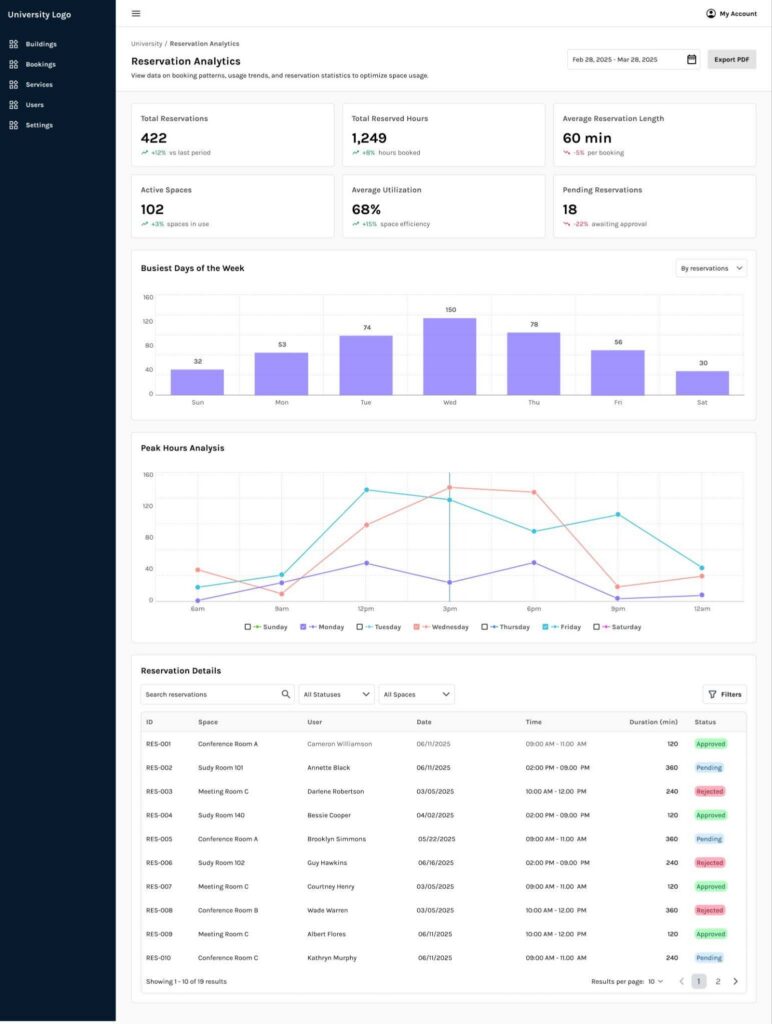
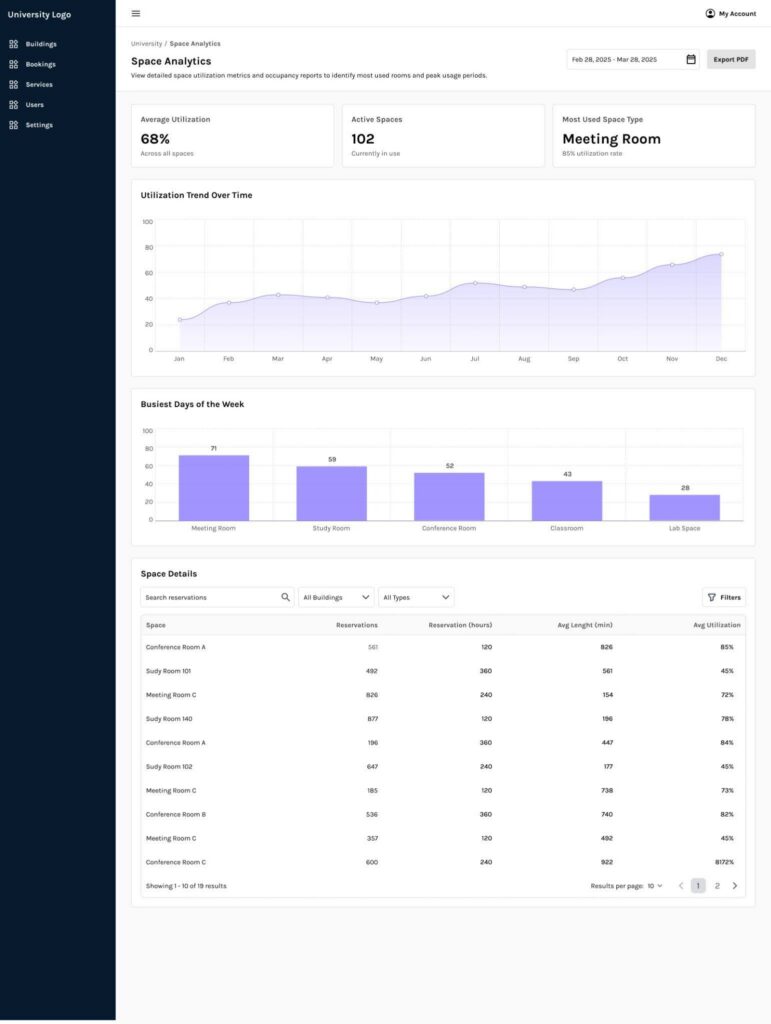
Reservation analytics can reveal surprising gaps, like rooms that administrators assume are in constant demand but show significant downtimes. Here’s what a utilization dashboard could look like in practice:
Example 2: Reducing Administrative Work
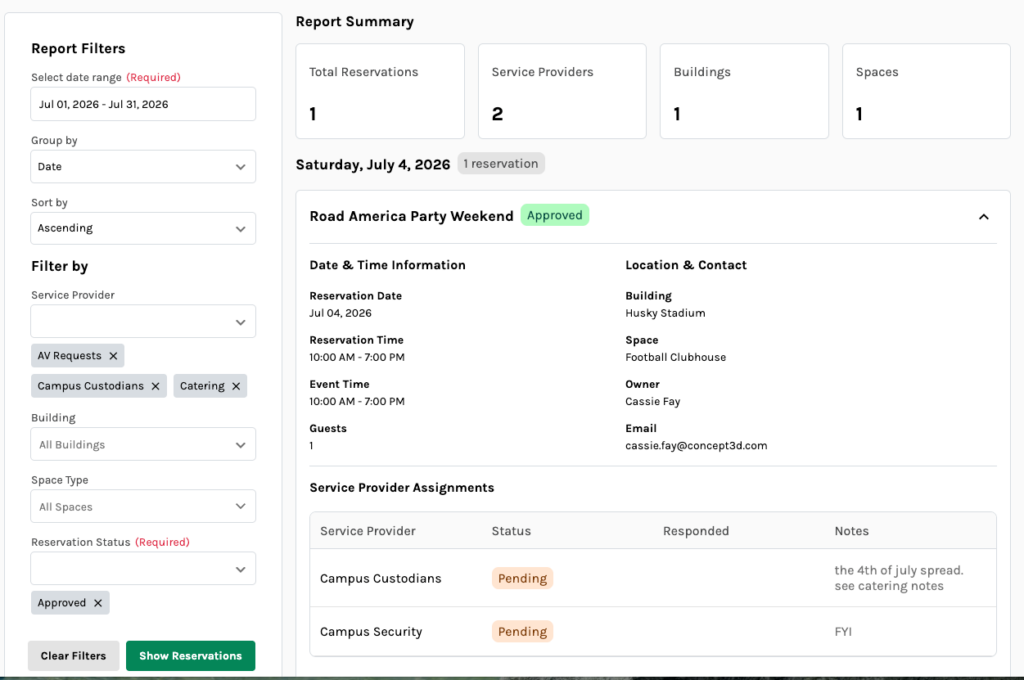
Managing reservation approvals across multiple departments doesn’t have to mean a chain of emails and manual follow-ups. Concept3D’s approval dashboard consolidates incoming requests into a single view, so administrators can review, approve, and assign service providers without switching systems:
Example 3: Improving Event Coordination
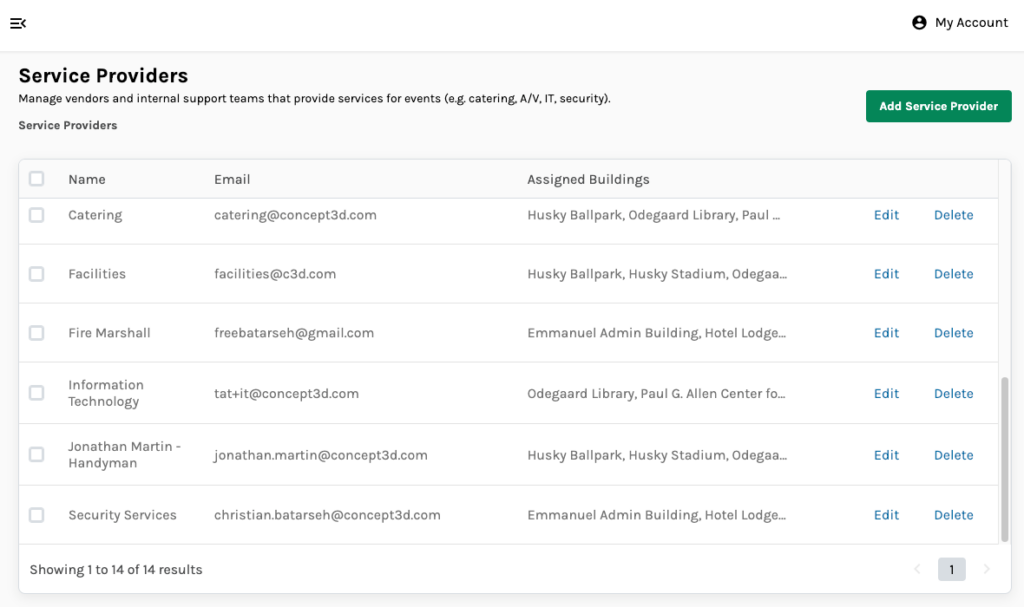
When a room reservation automatically notifies the right service teams, from facilities and catering to IT and security, the day-of logistics start to take care of themselves. Here’s what a service coordination workflow might look like on the admin side:
Example 4: Supporting Flexible Campus Spaces
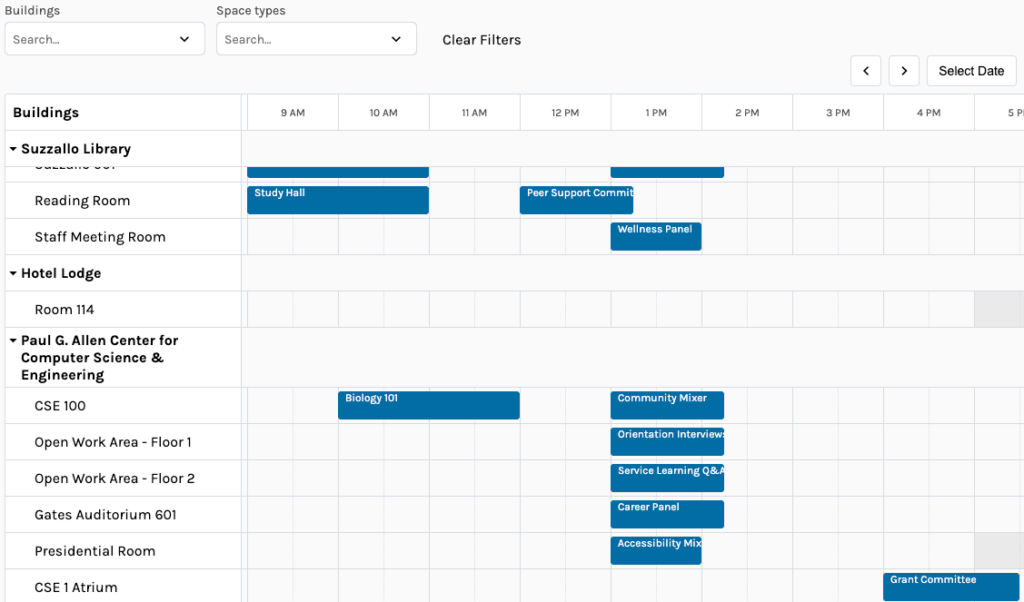
Classrooms, meeting rooms, and event venues all have different booking rules and audiences. But they don’t need to live in different systems. Here’s how institutions can manage the full range of campus spaces from one scheduling interface:

Example 5: Improving Reservation Visibility
When a reservation changes, everyone who needs to know should find out automatically, regardless of whether they’re checking a calendar, a digital display, or the scheduling platform itself. This is what synchronized, real-time reservation visibility looks like across campus:
How Different Campus Teams Benefit From Centralized Room Scheduling
Get your university room scheduling right, and the benefits start to spread across campus:
- Facilities teams gain real-time data on how spaces are used, supporting maintenance planning, custodial scheduling, and evidence-based capital requests.
- Academic departments reduce friction around classroom and meeting room reservations and gain visibility into whether the spaces they rely on are actually serving instruction.
- Conference and events teams manage external rentals and large-scale events more efficiently, with service coordination, billing, and room logistics in one platform.
- Student Affairs gives student organizations a self-service path to booking spaces for programming without routing every request through a coordinator.
Evaluating Your Campus Room Scheduling Process
Before selecting or upgrading room scheduling solutions, run your current process against these questions:
- Can users search for available spaces by capacity, amenities, and accessibility features without emailing someone?
- Are reservation policies enforced automatically, or do administrators manually review for rule compliance?
- Does your room scheduling system integrate with the registrar’s course scheduling to prevent conflicts with academic timetables?
- Can campus service providers receive automatic notification of their event-day responsibilities?
- Does reservation data sync automatically with calendars and digital signage?
- Do administrators have visibility into space utilization trends across buildings and room types?
- Can invoicing and billing for external rentals be managed within the same platform as the reservation?
Creating a room scheduling policy for your organization can also go a long way to ensure that the software is supported by comprehensive processes across the institution.
Moving Into the Next Stage of University Room Scheduling
At present, room scheduling is complex and complicated. But the future is bright. The trajectory points toward tighter integration and smarter automation.
Hybrid work and learning models have made space demand more unpredictable. Institutions that invest now in platforms capturing utilization data, enforcing policies automatically, and connecting reservations to service coordination will be better positioned as those demands continue to evolve.
When room scheduling works well, it’s invisible: students find spaces, events run smoothly, and administrators don’t have to manage conflict calls. But when it doesn’t, the friction shows up everywhere: in double bookings, frustrated staff, and rooms sitting empty while others are overbooked.
The solution is room scheduling solutions that:
- Enforce consistent policies
- Surface the right spaces to the right users
- Connect service coordination to the workflow
- Turn utilization data into actionable insight
That’s how to manage university room scheduling in a way that serves operations today and informs planning for the future.
Learn how Concept3D’s Room Reservations platform helps universities simplify scheduling and maximize campus space, or contact us with any questions.